Unidades Centrales de Apoyo a la Investigación Biomédica
Bioimpresión 3D


La Unidad de Bioimpresión 3D es una de las Unidades de apoyo científico-técnico que pone a servicio de investigadores de IMIBIC y de instituciones públicas o privadas los recursos necesarios para realizar su investigación en el ámbito de la bioimpresión.
El objetivo de la unidad es facilitar el desarrollo de proyectos de investigación en los cuales estén involucrados procesos de creación de constructos biomiméticos 3D, con aplicaciones en medicina regenerativa, farmacología y biotecnología. Proporcionamos asesoramiento y soporte científico-técnico en el proceso completo de impresión, desde la fase de pre-bioimpresión (desarrollo e implementación de ensayos de Bioimpresión3D), la puesta a punto y el establecimiento de parámetros de Bioimpresión, hasta la fase de final de caracterización y evaluación biológica de los constructos bioimpresos
La unidad dispone de una impresora de última generación completamente equipada garantizando la seguridad y viabilidad de los constructos bioimpresos.
Personal

Gema García Jurado, PhD
Responsable de Unidad.
- gema.garcia@imibic.org
- bio3d@imibic.org
- +34 957 213 753 (Corporativo 3753)
- +34 609 157 790

Alvaro Carrasco Carmona
Especialista Técnico Senior
Fundamentos y Aplicaciones de la Bioimpresión 3D
La bioimpresión 3D es un proceso que permite la creación de estructuras biológicas capa por capa, utilizando una variedad de células vivas y biomateriales (bioinks o biotintas). La precisión de esta técnica es fundamental para replicar tejidos complejos, como piel, vasos sanguíneos o incluso órganos completos. El éxito de la bioimpresión radica en los hidrogeles, compuestos que imitan las características físicas y la composición de la matriz extracelular, convirtiéndolos en candidatos ideales para aplicaciones en ingeniería de tejidos.
Las aplicaciones de la Bioimpresión 3D son muy variadas, y abarcan ámbitos muy diversos, entre los que se encuentran:
Biomedicina
- Cáncer. Modelos de microambiente tumoral de vasos celulares, reproducciones de matrices extracelulares, cultivos celulares y cultivo de organoides.
- Ingeniería de tejidos. Aplicaciones relacionadas con diferentes tipos de tejidos, incluyendo tejido epidérmico (regeneración de piel y estudios de monitorización de medicamentos), vascular, neuronal, muscular, cartílago y hueso.
- Investigaciones clínicas. Desarrollo de nuevos medicamentos y terapias. Estudios Xeno-Free eliminando todos los productos de origen animal.
Industria farmacéutica
- Desarrollo de modelos de órganos para screening de fármacos.
Industria alimentaria
- Creación de alimentos de estructura compleja.
Industria cosmética y perfumería
- Desarrollo de modelos artificiales para testar nuevos productos.
- Desarrollo de modelos cutáneos personalizados.
- Producción de fragancias sintéticas.
Equimamiento e infraestructuras
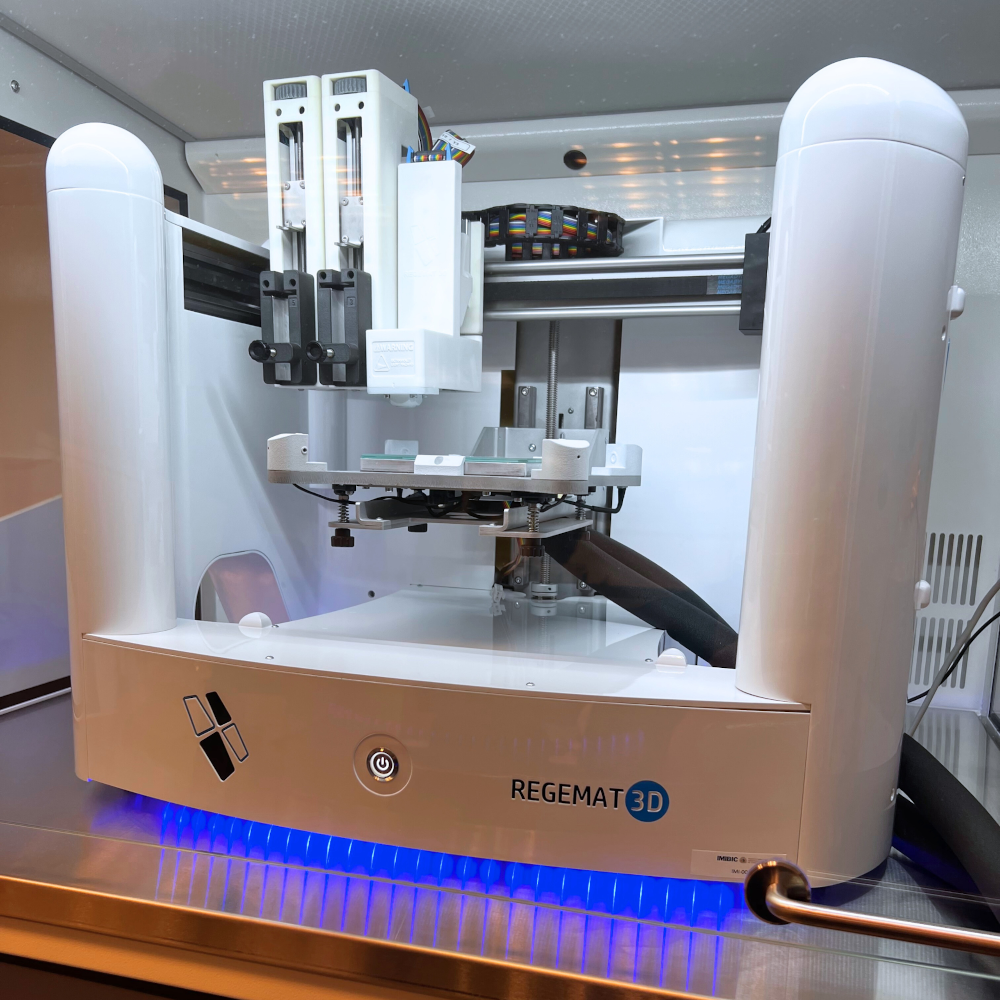
BIOIMPRESORA REG4LIFE (REGEMAT 3D)
- Impresora de extrusión mecánica
- Extrusión de biomateriales desde -20 hasta 100ºC
- Extrusión de termoplásticos hasta 250ºC
- Fotocurado con luz UV a 365nm y 405nm
- Jeringas con 0.15, 0.58 y 1.20 mm de diámetro de salida.
- Resolución real en los ejes X e Y = 150 μm (0.15 mm); Resolución en Z = 400 nm (0.4 micras). Resolución teórica en los ejes X e Y: = 1.875 micras – 1875 nm
- Disponibles jeringa de extrusión, bicomponente, coaxial, refrigerada, calefactada y de extrusión de alta temperatura
- Impresión en placa de cristal, placas de Petri y multipocillos
- Calibración automática de los ejes X, Y y Z
Más información => Especificaciones técnicas Bioimpresora 3D
Servicios
- Asesoramiento y soporte científico en técnicas de bioimpresión 3D
- Puesta a punto e implementación de nuevos ensayos de bioimpresión3D
- Establecimiento de parámetros para bioimpresión3D
- Validación biológica de hidrogeles funcionales
- Análisis de viabilidad celular en constructos bioimpresos y líneas celulares (ensayo LIVE/DEAD)
- Análisis de citotoxidad en constructos bioimpresos y líneas celulares (ensayo XTT)
- Caracterización morfológica de constructos bioimpresos (microscopía óptica y confocal).
- Medidas de absorbancia en placas de 96 (ensayos colorimétricos).
Más información => Especificaciones técnicas Lector de placas
Servicios