Estrategia en Recursos Humanos
Excelencia en Recursos Humanos en Investigación – HRS4R
El Instituto Maimónides de Investigación Biomédica de Córdoba (IMIBIC) se adhirió en 2015 a la Estrategia de Recursos Humanos para Investigadores (HRS4R). Esta estrategia fue lanzada por la Comisión Europea en 2005 para apoyar a las instituciones de investigación en la implementación de políticas de recursos humanos, con el fin de crear un mercado laboral transparente, atractivo y abierto para los investigadores, permitiéndoles desarrollar su labor científica en un entorno favorable y estimulante.
Esta estrategia HRS4R se basa en la Carta Europea del Investigador y en el Código de Conducta para la Contratación de Investigadores, que conforman la denominada Carta & Código (C&C):
- La Carta Europea del Investigador aborda los derechos y responsabilidades de los investigadores y de sus empleadores u organizaciones financiadoras.
- El Código de Conducta para la Contratación de Investigadores pretende mejorar la contratación de investigadores mediante procesos de selección más justos y transparentes.
La Carta Europea del Investigador y, en particular, el Código de Conducta para la Contratación de Investigadores se implementan a través de la estrategia de “Contratación Abierta, Transparente y Basada en el Mérito” (OTM-R). Este enfoque beneficia tanto a los investigadores como a las instituciones, apoyando además la plena realización del Espacio Europeo de Investigación (ERA) y aumentando la eficiencia de la inversión en investigación. En la práctica, OTM-R garantiza que se seleccione al candidato más adecuado, promueve el acceso y las oportunidades en igualdad para todos, fomenta el desarrollo de un perfil internacional mediante la cooperación, la competencia y la movilidad, y contribuye a hacer más atractivas las carreras investigadoras.
La estrategia HRS4R consta de cinco pasos:
- Realizar un análisis interno para comparar las prácticas actuales del IMIBIC con los principios de la Carta Europea del Investigador y del Código de Conducta para la Contratación de Investigadores, involucrando a todas las partes implicadas.
- Publicación de los resultados del análisis y del Plan de Acción.
- Aprobación de la Estrategia por parte de la Comisión Europea y concesión del sello HR Excellence in Research.
- Implementación del Plan de Acción y autoevaluación interna a los dos años.
- Evaluación externa por parte de la Comisión Europea cada tres años.
En 2015, el IMIBIC firmó una carta de compromiso con la Carta & Código (C&C) con el objetivo de implementar las políticas y buenas prácticas descritas en ambos documentos.
Durante 2016 y 2017, tomando como marco la estrategia europea HRS4R, se llevaron a cabo varias actividades para analizar el grado de cumplimiento de cada uno de los 40 principios establecidos por la C&C. A partir de dicho análisis, se detectaron áreas de mejora. Los resultados sirvieron como base para el desarrollo del Plan de Acción de Recursos Humanos del IMIBIC 2016-2020.
El IMIBIC fue reconocido por la Comisión Europea con el premio “HR Excellence in Research” en septiembre de 2017.
Desde 2017, el Plan de Acción se implementó y se monitorizó anualmente. En octubre de 2019, se realizó una autoevaluación intermedia, que incluyó un informe a la Comisión Europea sobre el progreso, el estado de los indicadores, así como las fortalezas y debilidades de las prácticas actuales, para su evaluación por expertos externos. Como resultado de esta autoevaluación del Plan y de la OTM-R en IMIBIC, se publicó un Plan de Acción actualizado 2020-2022. Asimismo, se estableció un documento específico de Política OTM-R para el IMIBIC, basado en el proporcionado por la Red Euraxess de la Comisión Europea en apoyo a los investigadores Euraxess
A comienzos de 2020, la Comisión Europea proporcionó la retroalimentación de los expertos externos respecto a los resultados de la estrategia HRS4R, correspondientes a los dos primeros años tras obtener el sello HR Excellence in Research. La evaluación felicitó al IMIBIC “por la implementación efectiva de la HRS4R, su pleno compromiso y sus esfuerzos de seguimiento durante la fase de implementación”.
El Plan de Acción 2020–2022 fue implementado y monitorizado a lo largo del periodo y, al finalizar, se elaboró una revisión interna. Esta sirvió, por un lado, para confirmar el logro del 96,55% de los objetivos inicialmente propuestos, y por otro, para reflexionar sobre la evolución del Plan y su alineación con los cambios ocurridos en el sistema del IMIBIC durante 2020–2022. A partir de esta base, y de la información recopilada durante el proceso de renovación de acreditación del Instituto por parte del Instituto de Salud Carlos III (ISCIII) —obtenida con éxito en 2021— se desarrolló el Plan de Acción 2023–2025, en línea con los principios de la C&C. Paralelamente, se llevaron a cabo actividades de difusión sobre el premio HRS4R (como la elaboración de un póster) entre el personal del Instituto. El Plan de Acción 2023–2025 ha tenido una monitorización continua durante y al final de cada año, además de una autoevaluación del Plan 2023–2025, incluyendo la revisión de objetivos e indicadores clave (KPI).Se esperaba recibir la evaluación externa de la Comisión Europea para la renovación del reconocimiento “HR Excellence in Research” en 2023. Sin embargo, la visita se ha retrasado por causas imprevistas y está prevista para finales de 2025. Los evaluadores europeos evaluarán in situ la implementación del Plan de Acción vigente y las acciones propuestas para el próximo Plan.
Cabe destacar que, a finales de 2023, la Comisión Europea actualizó la Carta Europea del Investigador, reemplazando la versión de 2005 (Carta & Código). La nueva Carta para Investigadores se lanzó en diciembre de 2023 y, al igual que en la versión anterior, subraya los derechos y responsabilidades de los investigadores y empleadores, así como de financiadores y responsables políticos. Pone énfasis en procesos de selección justos, abiertos y basados en el mérito, y comprende 20 principios clave organizados en cuatro grandes pilares:
- Ética, Integridad, Género y Ciencia Abierta.
- Evaluación, Contratación y Progresión de los Investigadores.
- Condiciones y Prácticas de Trabajo.
- Carreras en Investigación y Desarrollo del Talento.
En consecuencia, los nuevos principios establecidos en la Nueva Carta para Investigadores se han utilizado tanto para revisar y evaluar el Plan de Acción 2023–2025, como para desarrollar la estrategia del siguiente Plan de Acción 2026–2028.
En 2026, y en consonancia con el diseño del nuevo Plan Estratégico del IMIBIC 2026-2030, se ha trabajado en la elaboración del nuevo Plan de Acción HRS4R 2026-2028. Se ha diseñado de acuerdo con los principios y pilares de la Nueva Carta de los Investigadores y está plenamente alineado con el Plan Estratégico y los subplanes del IMIBIC para el periodo 2026-2030. En particular, se basa en un análisis exhaustivo de la aplicación y los resultados del anterior Plan de Acción 2023-2025. Este análisis, junto con los resultados de la encuesta de 2025 que evaluaba tanto el conocimiento que tenían los investigadores del IMIBIC sobre el HRS4R como sus necesidades en relación con sus diferentes pilares y principios, ha servido de base para las directrices estratégicas del nuevo Plan de Acción. Este proceso integral tiene como objetivo garantizar la consolidación y la mejora continua de la alineación del IMIBIC con los principios y normas del HRS4R.
- Charter & Code
- Open, Transparent, and Merit-Based Recruitment” (OTM-R)
- Letter of commitment
- Action Plan 2016-2020
- Internal review- Action Plan 2016-2020
- OTM-R Checklist 2019
- External review by European Commision - Action Plan 2016-2020
- Action Plan 2020-2022
- Internal review- Action Plan 2020-2022
- OTM-R policy for IMIBIC
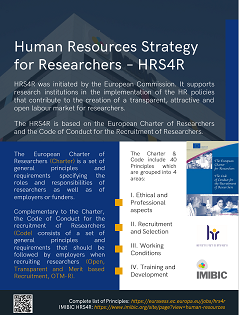
- Poster HRS4R
- Action Plan 2023–2025
- Internal Review- Action Plan 2023–2025 – Dec 2025
- New Charter for Researchers
- Strategy-Action Plan 2026-2028
- Action Plan 2026-2028
Empleo

Prácticas
Convocatorias